
Management System Certification Bodies
Find out how accreditation works for management system certification bodies in Singapore, and how it builds trust locally and across more than 50 economies worldwide.
Last updated on 3 August 2026
About
Accreditation is an endorsement of a certification body's independence, integrity and technical competence. Most importantly, accreditation provides a certification body with a trust mark and confidence to offer its services nationally and globally.
About the Scheme
The Accreditation Scheme for Quality Management System Certification Bodies was launched in October 1996 to maintain the standard of certification activities in Singapore. Since then, there are other related programmes launched such as the Accreditation programmes for:
Anti-Bribery Management System
Artificial Intelligence Management System
Asset Management System
Business Continuity Management System
Cold Chain Management of Chilled and Frozen Foods
Data Protection Trustmark
End-of-Life ICT Equipment Management System
Energy Management System
Environmental Management System
Facility Management System
Food Safety Management System
Good Distribution Practice for Medical Devices
Hazard Analysis Critical Control Point-based Food Management System
Information Security Management System
Learning Service Providers
Medical Device Quality Management System
Multi-Tiered Cloud Computing Security Management System
Occupational Health & Safety Management System
Privacy Information Management System
Quality Management System (including Quality Management for Bunker Supply Chain)
Water Efficiency Management System

*Accreditation Scheme for Food Safety Management System*
The accreditation scheme has progressively expanded over the years to meet industry needs:
Environmental Management System Certification (November 1999)
Quality Management for Bunker Supply Chain certification (August 2003), supporting the Maritime and Port Authority of Singa Certification pore’s initiative to highlight Singapore’s status as a bunkering hub
Occupational Safety and Health Management System certification (July 2005)
HACCP based Food Management System certification (September 2005)
Food Safety Management System certification to ISO 22000 (October 2006)
Good Distribution Practice for Medical Devices certification (April 2008), ensuring medical device quality throughout distribution in collaboration with Health Sciences Authority
Business Continuity Management certification (April 2010)
Energy Management System (EnMS) certification (July 2012)
Water Efficiency Management System certification (June 2013). Alongside with EnMS, these programmes support the increasing demand and need to optimise Singapore’s limited resources and the “green” movement
Learning Services Providers certification, Multi-Tiered Cloud Computing Security Management System certification and End-of-Life ICT Equipment Management System certification (2014)
Asset Management System certification (2015)
Medical Device-Quality Management System certification and Anti-bribery Management System certification (2017)
Information Security Management System certification (2018)
Cold Chain Management of Chilled and Frozen Foods certification (2021)
Privacy Information Management System certification and Facility Management System certification (2023)
Artificial Intelligence Management Systems certification and Data Protection Trustmark certification (2025)
Accreditation Criteria
SAC accredits certification bodies that can demonstrate compliance with the requirements and scope stated in SAC CT 01.
Benefits
Accreditation will:
Increase confidence
Widely recognised by regulators and the industry, SAC accredited certificates instil greater confidence in those who choose to engage the services of SAC accredited certification bodies.
International recognition
As a member of the Multilateral Recognition Arrangement (MLA) for Quality Management System of both the Asia Pacific Accreditation Cooperation (APAC) and the International Accreditation Forum (IAF), certificates issued by SAC accredited certification bodies are recognised worldwide by MLA members across more than 50 economies.
Process
Upon receiving the application for accreditation, qualified assessors are assigned to assess the system of operations of the certification body and the competence of the auditors. This will be carried out through a document review, assessments at the certification body's office as well as on-site witnessed assessments of audits – all conducted by the certification body. When the certification body has demonstrated compliance with our requirements, it will be recommended for accreditation. Once approved, SAC will grant a certificate of accreditation. The detailed description of the type of assessment is stipulated in CT 01, Accreditation Process.
The detailed description of the accreditation process can be seen below:
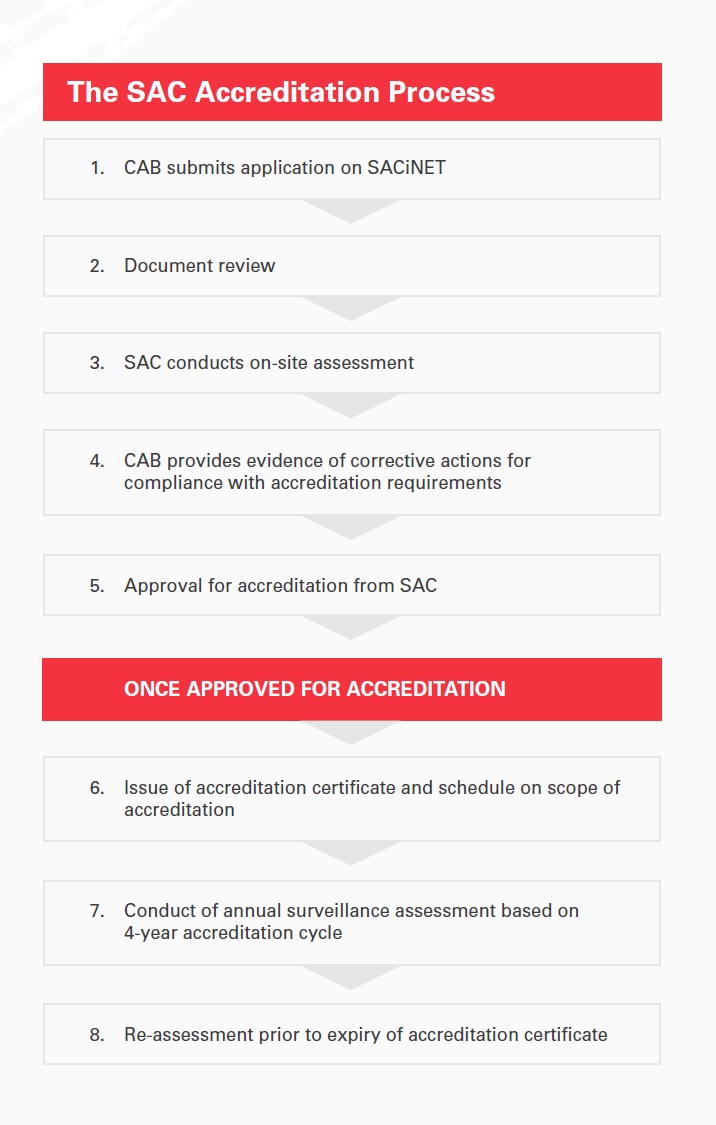
Upon fulfilling the basic requirements, the CAB can apply online through the SACINET website (opens in new tab){:target="_blank"}.